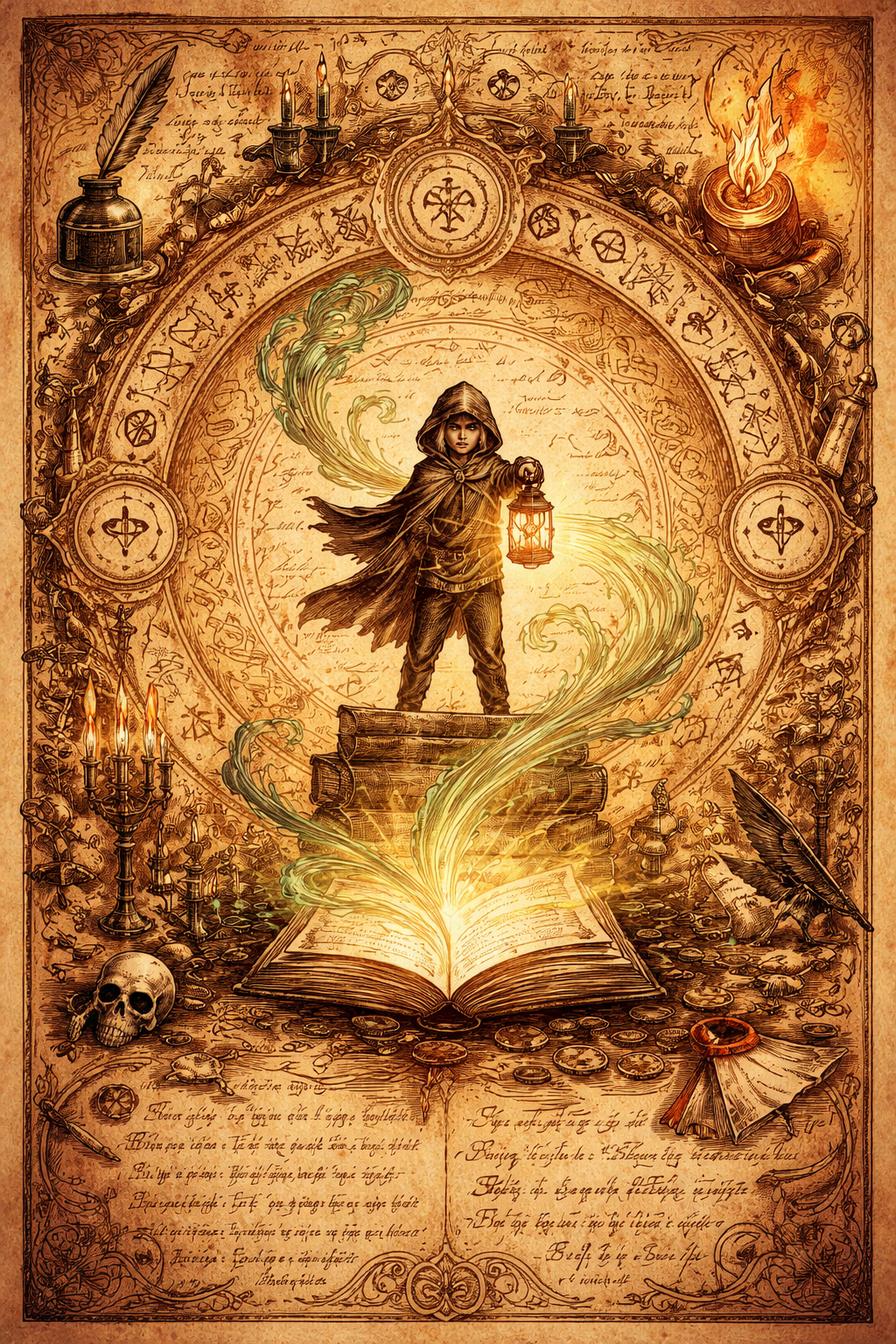
Chapter 1
“In a time once ago” are the five most powerful words one can utter. With them, spells are cast, heroes are born, and hearts are broken—but only in a time once ago.
—Teller Cabular the Thorough
……………
The chandler’s shop smelled like sweetness gone rotten.
Gray timber walls leaned inward beneath questionable thatching, and the far wall was coated in layers of tallow and old fats that had dripped and hardened over years of hard labor. Even in the dim gloom of the storehouse, it shone faintly, as if the walls themselves were sweating. Most people had to gag to keep their retched down, the first time they stepped inside.
Some failed.
Grammar Hensley was used to it—about as much as anyone could be used to the fetid, saccharine stink of drying oils and rendered fat. Even so, he hoped his business with Max would be quick. Experience told him it wouldn’t be.
“Well, well,” said Max, stepping in from the storefront. “If it isn’t my favorite street swine. What have you got for me today?”
The chandler looked as waxy and greasy as his candles. What little hair he had was slicked back with sweat and oil, and a lubricious mustache clung above a shifting constellation of blemishes. Gram had always joked that you could track the seasons by the peeling and redness of Max’s face. For all that, the man was thin as a taper and wiry as a wick.
All the boys in Bluff knew better than to cheat him.
Violence always seemed just beneath the surface of Max’s dark eyes and skeletal hands. He remembered slights, held grudges, and there were plenty of stories about boys who had come up short or tried to double-cross the chandler. The lucky ones ended up in gaol. Others vanished entirely—usually around the same time Max displayed a fresh batch of fatty candles in his window.
“Something good, I hope?” Max said when Gram didn’t answer.
Gram continued to stare at the cracked beam overhead, its length sagging under dozens of wax drippings that clung like insects caught in a spider’s web. He wasn’t easily intimidated, and Max knew it. Gram was one of his best filchers.
“I don’t have all day, boy,” Max snapped, pounding the workbench. “What did you bring me?”
Gram finally looked over, feigning surprise. “And salutations to you, Max.” He reached into the lining of his shirt and opened his hidden pocket—one that passed most inspections by the constabulary, and even the duke’s guards.
A gold pocket watch, a silver hairpin, and three copper Fractions clattered onto the bench.
“Not a bad fetch,” Gram said lightly. “If I may be so humble.”
Max ignored the performance. He snatched up the watch, scratched its surface with a nail, and watched the gold flake away to reveal tin beneath.
“Barely worth three Fracs,” he said, tossing it back.
“That’s nark.” Gram stepped closer. At fifteen, he barely reached the man’s chest, but he didn’t flinch. “Look at the engraving. That meant something to someone.”
They’d done this dance before. Max blustered. Gram haggled. Eventually, they’d land somewhere just shy of fair.
“I don’t pay for sentiment,” Max said. “If anything, I should charge you. Grinding that off will take time—unless you want me pinched by the Cons.” He sneered at the watch, but Gram caught the hunger behind it.
“One silver Figure,” Gram said. “And don’t lie. You’ll sell it for two.”
Max sighed theatrically and pulled a silver coin from his coffer. “One Fig. For the watch and the pin.”
“That’s robbery.”
“No,” Max said, smiling as he pocketed the hairpin. “Robbery is what you do. I’m just a poor candle maker trying to keep his business alive and feed his family.”
“That’s nark too,” Gram said, snatching the coin. “You’ve got cats, Max—and the only reason they stay is because you smell like something the fishery threw away. No crimson woman with half a wit would stand that stench.”
The silence afterward was immediate and heavy.
Gram reached for the staff by the door and missed it entirely.
Max moved faster than he looked. Fingers like wire closed around Gram’s throat, driving him back as the air vanished from his lungs.
“You don’t know what you’re talking about,” Max hissed.
Gram clawed uselessly at the man’s hands, vision blurring. Then, just as suddenly, Max released him.
They both knew Gram was too valuable to turn into candles—but the red ring around his neck would last for weeks.
“You talk too much,” Max said, pressing the Figure and the three Fractions into Gram’s hand. “One day it’ll get you killed. Today isn’t that day.”
He leaned in, smiling thinly.
“It’s a good thing I like you.”
“Aren’t you just a regular sweet talker?” Gram said after a fit of hacking and wheezing. “As always, it’s been a pleasure, Max.”
He turned to leave. A hand closed around his wrist.
“I didn’t say our business was finished.”
Max released him and reached into a nearby cabinet. He drew out a heavy, three-wick candle made of hazy, pearlescent wax and held it up between them.
“I need this delivered to Mr. Poe, in Bridgedowns.”
“I don’t go to Bridgedowns,” Gram said, already tucking his earnings into his hidden pocket.
“Today you do.” Max’s voice left no room for argument. “Besides, it’ll be good for you to get out of Grubtown. See the world.”
Gram studied the candle, then took it. “What’s the courier fee?”
Max smiled. “Poe will pay you two Nums.”
“Two golden Numbers?” Gram rarely lost his composure, but that was more money than he’d seen in a year of filching.
“Aye,” Max said. “You’ll bring them back to me by sundown.”
Gram shifted, keeping his distance. “What’s my cut?”
“Nothing,” Max said. “You do this for free, as penance for all the talk I endure while doing business with you.”
“I don’t work for free.” Gram turned away. “Find another flunky.”
Max stepped closer. The shadows beneath his eyes deepened, dark and slick as oil.
“You misunderstand,” he said quietly. “This wasn’t a request. If you don’t return by sundown with two golden Numbers, I’ll make sure there’s nowhere in this city you can run—nowhere to hide that grubby face of yours.”
He seized Gram’s cheeks, fingers pinching hard, forcing his mouth shut.
“If you refuse,” Max whispered, “the only cut you’ll earn will come in the middle of the night, while you’re asleep in some rat-infested backstreet.”
Gram felt very small.
No words came. None mattered.
At last, Max released him. Gram stumbled back, throat raw, pride burning.
“Got it,” he croaked.
He slammed the storeroom door behind him and stepped into the alley.
The afternoon air hit him like a slap. Courage and embarrassment surged together. Gram set the candle on the cobblestones and took two steps away, determined not to be drawn in by Max’s threats.
Then he stopped.
His hand brushed his aching throat. He lifted his staff, ready to smash the candle to pieces.
But he didn’t.
Even as he stared at it, Gram knew what he would do. He knew his role. As bad as Max was, there were worse fates for a boy alone on the streets of Bluff. He’d known boys who’d had to do far more than filch to survive.
With a hoarse sigh, he picked up the candle and headed toward the heart of the city.
You didn’t want to be caught in Bridgedowns when the sun dipped behind Blindman’s Pass. The old timers all said so.
He hurried.
Bluff was less a city than several cities grown together over time, a bloated vine patch of stone and street. Rover Downs cut through Saison Hill, which tangled into Whitewharf. Only two places escaped the sprawl: the Duke’s Castle and the Librarium, the school for tellers.
The Librarium stood apart, serene and aloof, its gray towers rising above the color and chaos of the streets. They drew the eye again and again—until, like clouds or fishmongers calling their wares, they became part of the city’s rhythm.
Always present.
Always above.
And whether the people of Bluff noticed it or not, the Librarium was watching all the same.
********